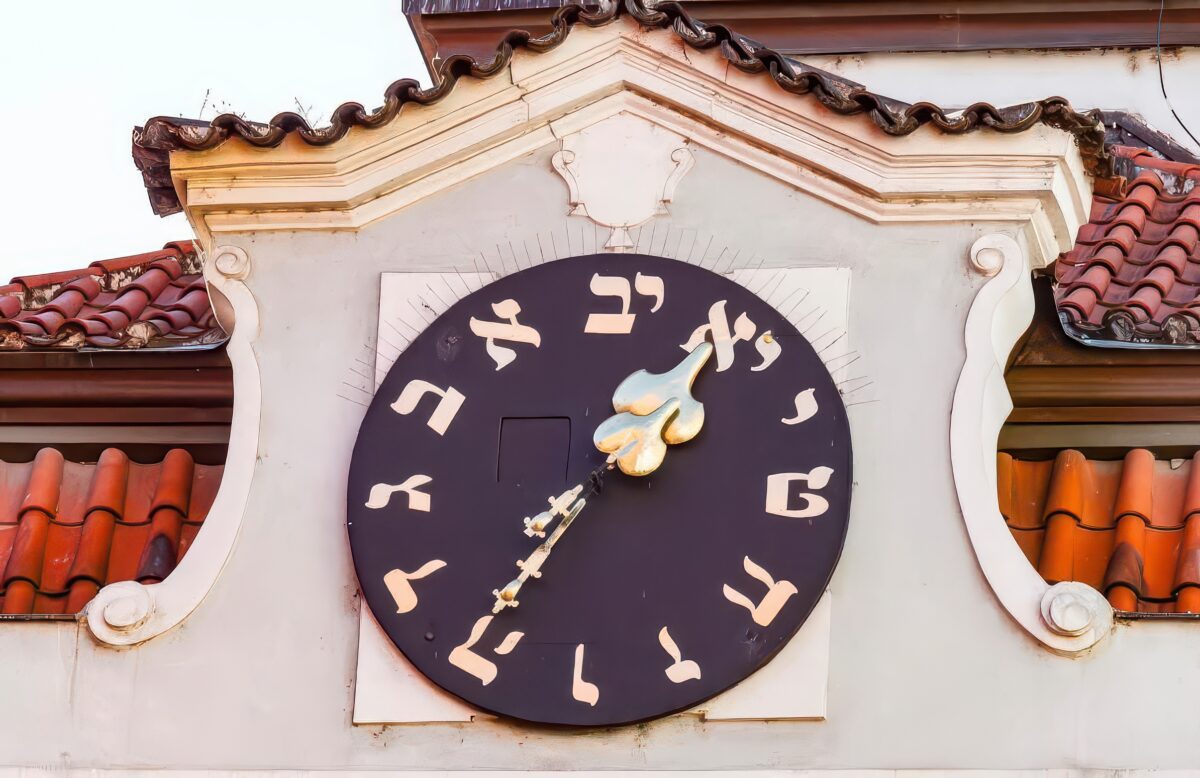
Keeping track of how God tells time
“These are YHVH’s appointed times which you shall proclaim.”
Every day in the synagogue, Jews pick up their Hebrew prayer books (the Siddur) and recite a passage based on God’s ancient declaration to Moses: “Blessed are You YHVH who sanctifies Israel and the times” (‘Baruch Ata YHVH meqadesh Yisrael v’zmanim’).
The original thought behind this prayer is found in Leviticus 23:2-4: “Speak to the sons of Israel and say to them: ‘YHVH’s appointed times which you shall proclaim as holy convocations – My appointed times are these.’” The God of Jacob repeats that principle again, stressing it in Leviticus 23:44: “So Moses declared to the sons of Israel the appointed times of YHVH.”
But many Jews don’t attend synagogue today. And countless Christians of all stripes consider Jewish feasts, fasts and prayers to be quaint but unimportant. Yet the God of the Bible declares that these feasts and festivals are uniquely His – “My appointed times” as it says in Leviticus 23:2.
What does God’s declaration mean, and what significance does it have for Jews and Gentiles who believe the Bible? What are the implications of YHVH’s declaration for the nations of the world and for their political and religious leaders? How are we all to keep track of how the God of Jacob tells time?
- The God of the Bible uses times and seasons as a strategic key to unfold His covenant purposes on earth and in heaven. In doing this, He sanctifies time through what some of us today call ‘the Jewish calendar’ and ‘the Jewish feasts.’ YHVH’s Hebrew calendar declares His sovereignty over all times and all seasons.
God’s sovereignty over darkness and light, the stars and the seasons
King Solomon proclaims: “There is an appointed time for everything, and there is a time for every matter under heaven” (Ecclesiastes 3:1). This started with the creation and manifestation of light to our universe: “Then God said, ‘Let there be light!’ And there was light. God saw that the light was good. And God separated the light from the darkness” (Genesis 1:3-4).
“He counts the number of the stars. He gives names to all of them” (Psalm 147:4). “Praise Him, sun and moon! Praise Him, all stars of light! Praise Him, highest heavens and the waters that are above the heavens! They are to praise the name of YHVH, for He commanded and they were created” (Psalm 148:3-5). The Jewish Siddur again reflects this biblical perspective: “Blessed are You, YHVH our God, King of the universe, who makes distinction between holy and normal, between light and darkness!”
Denying God’s sovereignty, His existence, His seasons
The prophet Jeremiah mourned the lack of spiritual discernment of many in Israel in his day, who did not bow the knee before YHVH’s sovereign creative power, but denied His ways, spurned His calendar and scorned His feasts: “But this people has a stubborn and rebellious heart. They have turned aside and departed. They do not say in their heart: ‘Let us now fear YHVH our God, who gives rain in its season, both the autumn rain and the spring rain – who keeps for us the appointed weeks of the harvest” (Jeremiah 5:23-24).
Paul of Tarsus echoes Jeremiah’s words, adding that not only Jews but also Gentiles stand guilty of this same spiritual denial:
- “For the wrath of God is revealed from heaven against all ungodliness and unrighteousness of people who suppress the truth in unrighteousness, because that which is known about God is evident within them; for God made it evident to them. For since the creation of the world His invisible attributes, that is, His eternal power and divine nature, have been clearly perceived, being understood by what has been made, so that they are without excuse. For even though they knew God, they did not honor Him as God or give thanks, but they became futile in their reasonings, and their senseless hearts were darkened. Claiming to be wise, they became fools…” (Romans 1:18-22)
Times and seasons can be changed only by God
Daniel the prophet was a top political advisor to the king of Babylon. He spoke from personal experience when he declared that YHVH “is He who changes the times and the periods. He removes kings and appoints kings. He gives wisdom to wise men, and knowledge to people of understanding” (Daniel 2:21).
Daniel understood that a repudiation of God’s Leviticus 23-based calendar is, at its heart, a denial of God’s sovereignty. Those who make light of the biblical calendar end up mocking the crafter of that calendar – the God of the Jews and the sovereign shaper of history. Daniel notes that it is the anti-Christ/ anti-Messiah spirit which attempts to adulterate those biblical perspectives strongly rooted in the Hebrew calendar. Our day has seen a mushrooming of such attitudes:
- “And he [i.e. the anti-Messiah] will speak against the Most High and wear down the saints of the Highest One. And he will intend to make alterations in times and in law” (Daniel 7:25)
The zenith of Creation’s first week is the seventh day
- “And God saw all that He had made, and behold, it was very good. And there was evening and there was morning, the sixth day. And so the heavens and the earth were completed, and all their heavenly lights. By the seventh day God completed His work which He had done, and He rested on the seventh day from all His work which He had done. Then God blessed the seventh day and sanctified it, because on it He rested from all His work which God had created and made” (Genesis 1:31-2:3)
YHVH calls Himself the God of the Jews (see Genesis 26:24; 28:13; 31:42; 32:9; Exodus 3:6,15-16) roots. He entrusted the entire Bible to the Jewish people (see Romans 3:1-2). The God of Jacob tells the Jewish people that the feast days of Leviticus 23 are “your appointed feasts … a reminder before your God” (Numbers 10:10).
The weekly Day of Rest (Hebrew, the Shabbat) begins in Genesis on the seventh day of Creation. YHVH established this day as special and holy from the very beginning (see Genesis 2:3). Thousands of years before Abraham was born, God set His stamp on Shabbat for all time.
- “Remember the Sabbath day, to keep it holy. For six days you shall labor and do all your work, but the seventh day is a Sabbath of YHVH your God; on it you shall not do any work, you, or your son, or your daughter, your male slave or your female slave, or your cattle, or your resident who stays with you. For in six days YHVH made the heavens and the earth, the sea and everything that is in them, and He rested on the seventh day. For that reason YHVH blessed the Sabbath day and made it holy” (Exodus 20:8–11).
Moses and the Prophets later communicate that the Lord of Eternity put a divine seal on the Shabbat, crowning it as an especially Jewish sign-day for all the days of time and space:
- “Now as for you, speak to the sons of Israel, saying, ‘You must keep My Sabbaths. For this is a sign between Me and you throughout your generations, so that you may know that I am YHVH who sanctifies you’” (Exodus 31:13)
- “Sanctify My Sabbaths. And they shall be a sign between Me and you, so that you may know that I am YHVH your God” (Ezekiel 20:20)
- “They shall also keep My teachings and My statutes and all My appointed feasts, and sanctify My Sabbaths” (Ezekiel 44:24, describing the celebration of Shabbat in Jerusalem’s future Millennial kingdom)
God grants to the Sabbath a weekly preeminence and priority
In Leviticus 23 (the biblical chapter which highlights the Jewish year’s complete feast calendar) the God of Jacob emphasizes something that most of us rarely think about when considering the Jewish feasts. The yearly feast-cycle begins with God commanding the celebration of the Shabbat (Leviticus 23:3). The high point of each week is to be the Shabbat, a remembering of YHVH’s sovereign authority over everything that He has created:
- YHVH spoke again to Moses, saying, “Speak to the sons of Israel and say to them, ‘YHVH’s appointed times which you shall proclaim as holy convocations – My appointed times are these: For six days work may be done, but on the seventh day there is a Sabbath of complete rest, a holy convocation. You shall not do any work; it is a Sabbath to YHVH in all your dwellings’” (Leviticus 23:1-3).
The Jewish Sabbath in the boxing ring of the Gentile Church
As Roman and Greek Replacement Theologians grasped the Jewish Scriptures with gnarled anti-Semitic hands, they began to perform spiritual plastic surgery on the Bible. The Genesis Shabbat was incrementally morphed into a Gentile-Christian Sunday. And in short order, Sunday-worship became a theological litmus test of Christian orthodoxy. Those who held to a biblical seventh-day Shabbat (like the Jewish apostle Saul of Tarsus; see Acts 13:14, 42-44; Acts 16:13; Acts 17:2; Acts 18:4) were eventually rejected as heretics. Gentile Christians rapidly drained Shabbat-keeping (which had been the practice of the original Jewish apostolic body of Messiah) from church liturgy and observance. Instead, anti-Shabbat and anti-Jewish-feast tendencies were soon to become the church’s theological conviction and religious practice.
The reasons stated by the church for rejecting Jewish feasts and the Jewish Shabbat were not based on any biblical mandate; they were anchored in cold-hearted anti-Jewish attitudes. Here are some dishonorable milestones in that metamorphosis:
Ignatius of Antioch, written between Antioch and Rome, circa 107-110 AD – Epistle to the Magnesians:
- “Let us therefore no longer keep the Sabbath after the Jewish manner, and rejoice in days of idleness … Let every one of you keep the Sabbath after a spiritual manner, rejoicing in meditation on the law, not in relaxation of the body, admiring the workmanship of God, and not eating things prepared the day before, nor using lukewarm drinks, and walking within a prescribed space, nor finding delight in dancing and clapping which have no sense in them. And after the observance of the Sabbath, let every friend of Christ keep the Lord’s Day [i.e. Sunday] as a festival, the resurrection day, the queen and chief of all the days of the week.”
- “It is absurd to profess Christ Jesus, and to Judaize. For Christianity did not embrace Judaism, but Judaism [embraced] Christianity, that so every tongue which believes might be gathered together to God . . . It is absurd to speak of Jesus Christ with the tongue, and to cherish in the mind a Judaism which has now come to an end. For where there is Christianity there cannot be Judaism.”
Justin Martyr, penned in Rome 155 AD – Dialogue with Trypho the Jew, 18, 2:
- “The Sabbaths, and in short all the feasts, . . . were enjoined on you [Jews] – namely, on account of your transgressions and the hardness of your heart. . . God enjoined you to keep the Sabbath . . . on account of your unrighteousness and that of your fathers . . ." (Dialogue with Trypho the Jew, 18; chapter 21).
- “But Sunday is the day on which we all hold our common assembly, because it is the first day on which God, having wrought a change in the darkness and matter, made the world; and Jesus Christ our Savior on the same day rose from the dead. For He was crucified on the day before that of Saturn (Saturday); and on the day after that of Saturn, which is the day of the Sun, having appeared to His apostles and disciples” (Justin Martyr, First Apology, chapter 67: weekly worship of the Christians).
Constantine the Great; written in the Balkans; March 7, 321 AD – Corpus Juris Civilis Cod., lib. 3, lit. 12, 3:
- “Let all judges, the people of the cities, and the officials of all the courts rest on the venerable Day of the Sun, and let all workshops be closed. Given on the Nones of March, in the consulship of Crispus.” Flavius Julius Crispus was the eldest son of Emperor Constantine the Great and served as a Roman consul in 318, 321 and 324.
- “Let us then have nothing in common with the most hostile rabble of the Jews ... In pursuing this course with a unanimous consent, let us withdraw ourselves, my much honored brethren, from that most odious [Jewish] fellowship” (Constantine the Great, quoted in Eusebius’ Ecclesiastical History, Isaac Boyle, translator, 1995, p. 52)
Bishop Eusebius of Caesarea Maritima, 335 AD; one of the Fathers of Church History:
- “Wherefore as [the Jews] rejected [the Sabbath law], the Word [Christ] translated and transferred the feast of the Sabbath to the morning light by the new covenant, and gave us the symbol of true rest – that is, the saving Lord’s Day, the first [day] of light, in which the Savior of the world, after all His labors among men, obtained the victory over death, and passed the portals of heaven, having achieved a work superior to the six-days creation. On this day, which is the first [day] of light and of the true Sun, we assemble, after an interval of six days, and celebrate holy and spiritual Sabbaths – even all nations redeemed by him throughout the world, and do those things according to the spiritual law, which were decreed for the priests to do on the Sabbath. And all things whatsoever that it was the duty to do on the Sabbath, these we have transferred to the Lord’s Day, as these more appropriately belong to it, because it has a precedence and is first in rank, and more honorable than the Jewish Sabbath” (Eusebius: Commentary on the Psalms, specifically regarding Psalm 92)
The Council of Laodicea, Canon 29; 365 AD : “Christians must not Judaize by resting on the Sabbath, but must work on that day, rather honoring the Lord’s Day, and, if they can, resting then as Christians. But if any shall be found to be Judaizers, let them be anathema from Christ.”
It’s hard to tell time while ignoring God’s Jewish calendar
The Body of Christ got off to a bad start, developing a theology and a Last Days perspective which rejected YHVH’s calling on the Jewish people. It replaced the calling of Jacob with a non-biblical ‘priority of the Gentiles.’ Theological sleight-of-hand moved Shabbat to Sunday and replaced the Jewish biblical feasts with a ‘Christian Calendar’ chock full of newly-created ‘Saint’s Days.’
Something was lost in this ‘Gentilizing’ process. God’s prophetic calendar and His gifts and calling to the Jewish people are not items that can be blithely ignored. The entombment of the truth and light that these Jewish riches could have brought to the body of Christ has weakened the Christian world for ages, depriving it of the full counsel of God and sapping it of spiritual clarity and discernment.
But God and His purposes are not stymied. He is raising up voices which are restoring His truth about the Shabbat. Before he was murdered, Charlie Kirk published a book ‘Stop, in the Name of God: Why Honoring the Sabbath Will Transform Your life’. And 2,700 years ago the prophet Isaiah prophesied of a coming day when Messiah Yeshua will sit on David’s throne in Jerusalem, and the entire planet will once again celebrate YHVH’s appointed times, His feasts and His Sabbaths:
- “For just as the new heavens and the new earth, which I make, will endure before Me, declares YHVH, so will your descendants and your name endure. And it shall be from new moon to new moon and from Sabbath to Sabbath, all mankind will come to bow down before Me, says YHVH.” (Isaiah 66:22–23).
The rise of the Messianic Jewish movement in the 1800’s and 1900’s is a token of this fast-approaching prophetic day. “Messiah Yeshua is the same yesterday, today, and forever” (Hebrews 13:8).
Loving Passover seders but scorning the Shabbat
Over the past sixty years, many Evangelicals have had the joy of experiencing the richness of a ‘Christ in the Passover’ demonstration. They have discovered how Messiah Yeshua’s Last Supper was truly a Jewish Passover meal, and that those elements lie at the heart of what is today known as ‘communion.’ They have heard about the future Messianic celebration of the Passover, as Yeshua prophesied: “For I say to you, I will not drink of the fruit of the vine from now on until the kingdom of God comes” (Luke 22:17-18).
Yet, while Evangelicals appreciate one or two Jewish feasts, some often have a knee-jerk reaction to the continuing relevance of the Shabbat. Some of this is due to a suspicion or fear of the Mosaic covenant – what could be termed ‘Shabbatophobia.’ The Shabbat was given at the dawn of creation, which means that Adam and Eve kept Shabbat. But later the Shabbat was also made part of the Mosaic covenant (see Exodus 20:1-12; Exodus 31:13-16). Nearly two millennia of anti-Semitism and an anti-Mosaic attitude have taken their toll, and these negative attitudes to Shabbat are often a litmus test of other deeper spiritual infections. It is worth remembering that Isaiah prophesies that the Shabbat will be part of the New Covenant order in days to come (Isaiah 66:22-23).
How shall we then pray?
- Pray for the God of Jacob to grant revelation to believers everywhere about the Jewish foundations of His prophetic calendar, and heightened awareness of what is coming down the pike
- Pray that YHVH will expose and annul anti-Semitic theology and activism throughout the planet, wherever these snake-like evils raise their virulent heads
- Pray for the raising up of Ezekiel’s prophetic Jewish army throughout the earth!
Your prayers and support hold up our arms and are the very practical enablement of God to us in the work He has called us to do.
In Messiah Yeshua,
Avner Boskey
Donations can be sent to:
FINAL FRONTIER MINISTRIES
BOX 121971 NASHVILLE TN 37212-1971 USA
To donate online visit: http://www.davidstent.org/give